vince liwongan

Enedym Inc.

Replacing Altium 365 in-house

Full Stack Developer Co-op at Enedym Inc., an electric motor startup. Hamilton, ON. Sept to Dec 2026.

Altium 365 is the paid cloud tool Enedym uses for PCB design storage, review, and parts libraries. Think git for hardware design. I'm leading its in-house replacement, built on the company's internal platform, PULSE.

I took it from research to a working pilot with hardware engineers.

Fig. 1 / Save for Review pipelineInteractive

Step 1 of 5

An engineer clicks "Save for Review" in Altium Designer.

2,000
parts imported
12,000
part revisions
~300
design projects migrated to SVN
$[TBD]/yr
Altium 365 cost replaced

What I built

  1. A service that watches SVN

    I designed and shipped a Go service on GCP that watches the company's SVN design server and automatically sends each engineer's design save to PULSE for review.

  2. A button inside Altium

    I built an Altium Designer add-in and installer, deployed on engineers' PCs. It adds a one-click "Save for Review" button that generates the review PDF and commits the design.

  3. The review app

    I improved the Vue 3 and TypeScript schematic and PCB review app: 3D PCB renders, @mentions with email notifications, and a library view of all 2,000 parts.

  4. The parts library

    I built the parts library import: 2,000 parts and 12,000 revisions moved from Altium 365 into PostgreSQL. Cut import processing memory from 1.1 GB to [TBD].

  5. Moving 300 projects

    I planned and scripted the migration of about 300 design projects from Altium 365 into SVN.

  6. AI design review

    I'm designing two AI design-review tools with the hardware team: a one-click connectivity check in Altium that catches unconnected nets and shorts, and a Claude-powered deep schematic review in PULSE that runs on every saved design.

  7. Firmware

    I took over the production test and flashing station for a motor drive controller board. I'm building a TI C2000 bootloader and merging the secure flashing path (JTAG lock/unlock, encrypted firmware over CAN) with PULSE's firmware delivery.
Built with Go, PostgreSQL, Vue 3, TypeScript, Python, GCP (Cloud Run, Compute Engine, Cloud Tasks), SVN, Docker, GitLab CI, Altium Designer scripting, and TI C2000/CCS.

Currently building

Cortex: my own app for tracking life stats. Instead of checking a bunch of apps, it pulls their data into one place.

Progress log

  1. Nov 2026Started building.

WATonomous

MPC vs. Adaptive Pure Pursuit

Software Developer on the student design team: autonomous vehicle and humanoid robot. C++, ROS2, Docker, CARLA, Foxglove.

Plain pure pursuit was fine at low speeds, but the car needed to handle faster driving and tighter paths. I tested MPC and Adaptive Pure Pursuit in CARLA. MPC needed a lot of optimization to run fast enough, even on a strong PC. Adaptive Pure Pursuit is basically one formula with a few numbers to tune, so we tuned it in sim until it looked right, then tuned it again on the real car.

I also test arm and shoulder motor movement on the humanoid robot, with a Jetson Orin Nano over CAN bus.

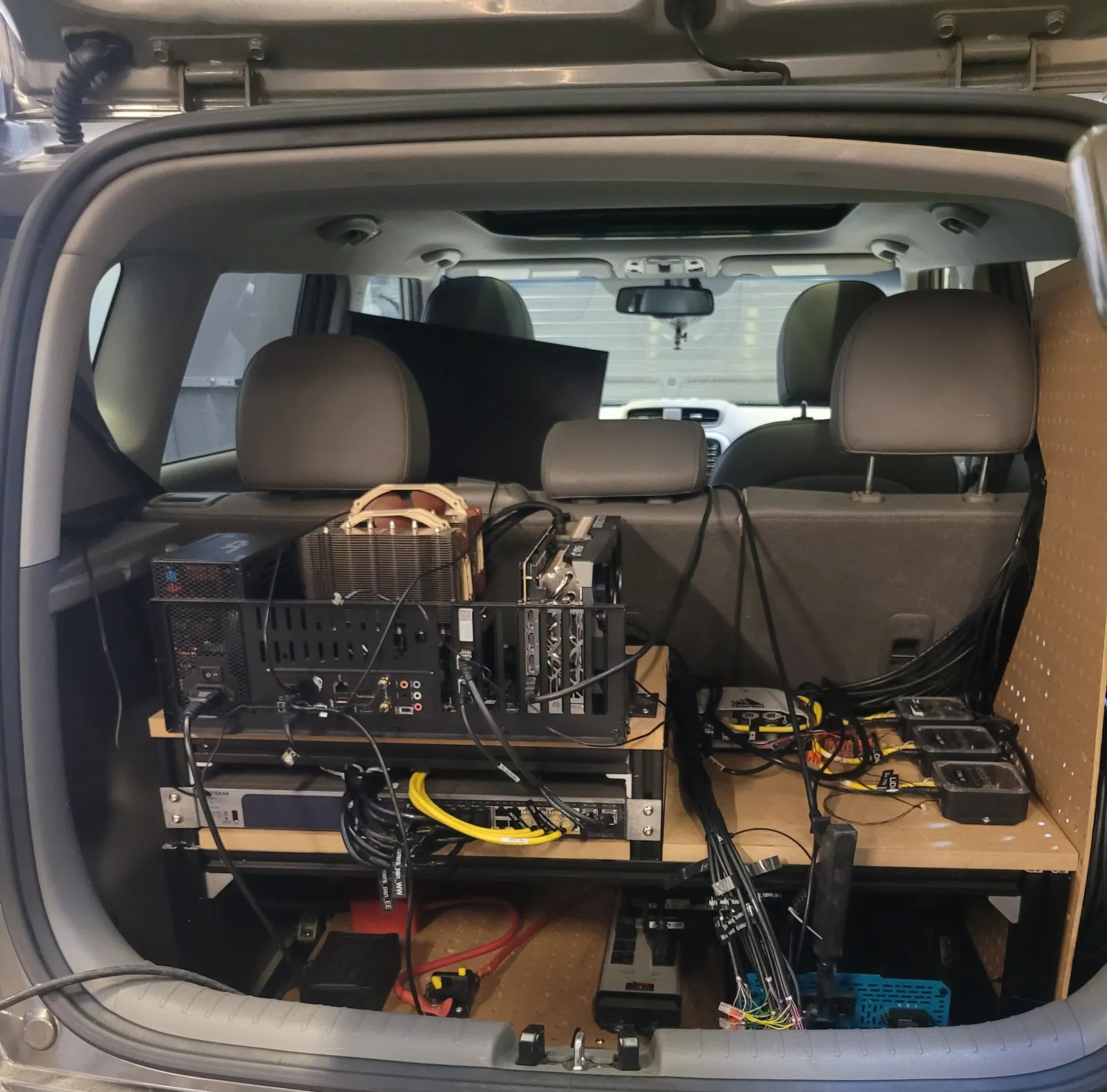
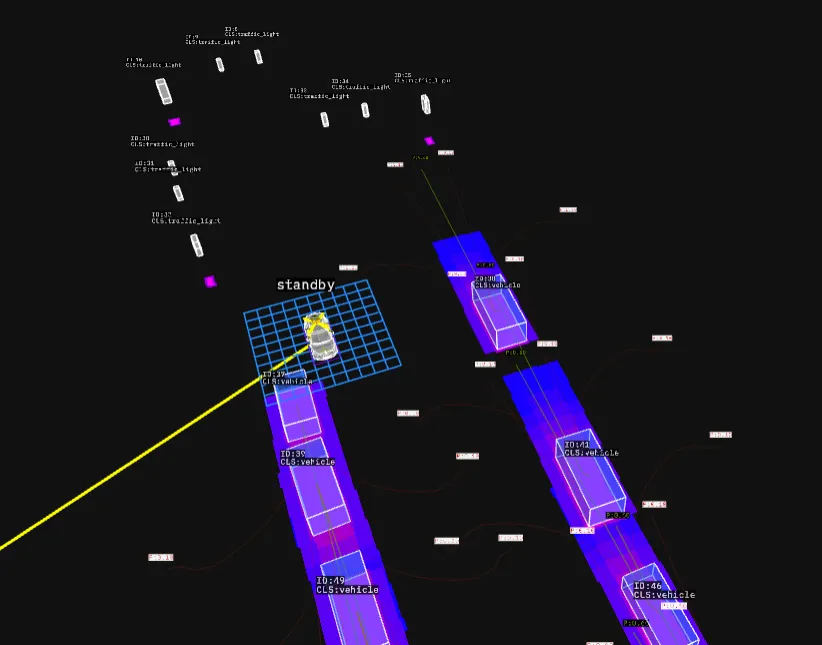
The computers mounted in the trunk of the WATonomous carVisualization from a controller test in CARLA simulation
Fig. 2 / Pure pursuit vs. adaptive pure pursuitInteractive
Controller

Fixed lookahead. Fine when slow. At high speed it overshoots and oscillates.

Top-down view of a car following a curvy closed trackThe car chases a lookahead point on the track ahead of it. With a fixed lookahead at high speed the car weaves across the track. With a lookahead that scales with speed it follows the track smoothly.
Lookahead
Cross-track error
Peak, last 5 s
path drivenlookahead pointtrack centerline
+4 m−4 mcross-track error, last 8 s

Press Play, then switch controllers. Try it at different speeds. A simplified model running in your browser: a kinematic bicycle with a small steering delay. It is not the WATonomous stack.

Side find: CARLA's steering was attenuated, effective angle ≈ 0.555 × commanded².

Fig. 3 / Commanded vs. effective steeringInteractive
Effective steering angle against commanded steering angleA straight ideal line where effective equals commanded, and a measured curve, 0.555 times commanded squared, that sits well below it.0.00.00.20.20.40.40.60.6commanded δ (rad)effective δ (rad)ideal: effective = commandedmeasured: 0.555·δ²
Top-down view: a solid car follows the effective steering angle, a ghost car follows the commanded anglestart
effective (what the sim car does)commanded (ghost)
Commanded
Effective
Steering lost